
embracing empathy-
Managers, Supervisors, and Team Leads at Corporate Co. struggling with communication and teamwork.
-
Instructional Design
Action Mapping and Needs Analysis
Storyboarding
Visual Design
Mockups
Animation and Motion Graphics
Video Editing
Audio Production
-
Articulate Storyline 360
Vyond
Adobe Illustrator
Adobe Audition
Miro
Movavi
-
By the end of this course, learners will demonstrate the following required, on-the-job behaviors:
- Listen actively rather than waiting for your turn to respond
- Take the time to see a situation from another's point of view
- List the potential outcomes of a decision and how it affects team members
- Remove personal bias to make better decisions for the team
- Pay attention to nonverbal cues from others
-
The company’s turnover rate will reduce 15% by the end of the year as the managers and team leads apply emotional intelligence techniques gained from this course.
I designed and developed this scenario-based eLearning concept project to provide the department managers at this company an opportunity to practice and improve their emotional intelligence skills in a real-life, low-risk environment.
Managers and team leaders are exposed to real-life simulations that will increase positive communication and teamwork within the company, ultimately leading to an improved retention rate.
This sample module is part of a full learning path that includes multiple courses and modules. Read below for an insight into my full analysis and design process.
-
The Problem
-
The Solution
-
The Design Approach
-
Process / Action Map
-
Storyboard/Prototype
The ProblemHigh turnover at Corporate Company is negatively impacting team productivity and the company’s performance overall.
-
Corporate Company identified a high turnover rate as a significant factor in a disappointing performance for the last few quarters. The HR Director was tasked with identifying strategies to address the issue, and a new goal was implemented:
Employee Retention rate will increase 10% by the end of the year as department managers complete conflict management training.
However, by the end of the year, there was very little change to the retention rate, and the company was still struggling with high turnover. The HR Director reached out to me to design and develop a training intervention.
Utilizing Cathy Moore’s strategies, I analyzed the company’s goal with the HR Director to identify where to tighten the focus.
After conducting interviews and reviewing information from employee engagement surveys, it became clear that there were three main issues the HR director was facing:
Problem 1: Employees did not feel connected with their team lead or manager and often got the impression that their manager was unreachable, unapproachable or just did not have time for them.
While the HR director approached me originally for a training course, I determined that training would not address this part of the problem. One-on-one meetings between employees and managers were infrequent, usually only occurring during annual performance reviews. This lack of regular communication led to difficulties in initiating meetings and collaboration, especially for new employees. Additionally, the few meetings that did occur often had negative connotations and were usually associated with disciplinary actions.
Problem 2: Many team members were unsure of where to find information or even policies.Even some of the managers could not immediately locate vital documents, and simply operated off what they knew or “the way things are done around here.” This ambiguous organization system was mentioned multiple times in exit interviews as a major source of confusion and frustration. I identified this situation as an environmental issue, not necessarily a training issue.
Problem 3: There was a lack of clear communication inside departments that was contributing to a negative atmosphere and relationships.
For this issue, the company already implemented conflict management training, but there had been no noticeable difference in the survey results or the amount of employees leaving.
After discussion with the HR Director and other SMEs, we determined that the conflict management training was more of a reactive intervention that did not fully address the root problem - poor communication and relationship building. The training offered no opportunity for managers to roleplay proper and positive communication.
I recommended implementing emotional intelligence (EI) training. Leveraging my background in Education and social-emotional development, I devised an immersive eLearning program.
This scenario-based training allows learners to practice and enhance their EI skills in a realistic yet risk-free environment. By making more informed decisions during office interactions, managers can improve communication, teamwork, and ultimately boost productivity.
The Solution-
Problem 1: Employees did not feel connected with their team lead or manager and often got the impression that their manager was unreachable, unapproachable or just did not have time for them.
Solution: To address this, I suggested implementing monthly or quarterly 1-on-1 meetings with managers and direct reports.
This structured time would encourage open communication channels and offer a more consistent avenue for employees to bring thoughts and concerns to managers.
The HR Director agreed, and made plans to include this measure as an expectation for department managers moving forward.
Problem 2: Many team members were unsure of where to find information or even policies.
Solution: I suggested that rather than spending time and money on training for this part of the issue, it would be better to allocate those resources towards a better documentation system or software.
The Director agreed that the software used to house the company’s documentation was clunky and difficult to navigate. She made a note to speak to the CEO about investing in a new one.
Problem 3: There was a lack of clear communication inside departments that was contributing to a negative atmosphere and relationships.
Solution: I agreed that training would still be a good option here. With my background in mental health and adult education, I proposed training around Emotional Intelligence principles.
Communication and relationship building are skills that can be taught and learned, especially with adequate practice. I explained that providing department managers with an opportunity to practice applying emotional intelligence techniques and principles in a low to no -stakes environment would help them build those skills. It is a much more proactive response that seeks to address behaviors that lead to conflict, rather than simply reacting and managing conflict after it has already occurred. The HR Director was familiar with the concept and was very receptive.
While emotional intelligence is an important skill for everyone, the department managers at Corporate Company were directly affecting their team environments. By teaching managers emotional intelligence techniques, they are able to model the behaviors and positively impact their team members.
After deciding on this approach, I helped the Director rework the goal to look like this:
The company’s turnover rate will reduce 15% by the end of the year as the managers and team leads apply emotional intelligence techniques gained from this course.
With influences from Cathy Moore, I designed this project based on the ADDIE model and focused on scenario-based learning for effective behavioral change.
Instead of traditional delivery methods, I aimed for full immersion, ensuring learners recognize familiar situations for better skill application. To enhance engagement and retention, I integrated interactive graphics, gamified elements, and realistic characters.
Design Approach-
I designed an immersive eLearning experience based on the ADDIE model. Instead of relying on traditional information delivery methods, I opted for a more engaging, scenario-based approach. By placing learners in familiar situations, they have the opportunity to process challenging scenarios in a low- to no-stake environment and practice applying emotional intelligence techniques from the course.
To enhance engagement and retention, I incorporated gamification elements such as interactive graphics, responsive maps, and branching scenarios. Each decision includes authentic prompts and responses, preparing learners for real-world situations in the workplace.
My Process & Action MapI collaborated with stakeholders, including key managers and employees to identify consistent issues within Corporate Company's office environment. With client approval, I utilized my expertise in emotional intelligence to design a course focused on clearly defined, applicable behaviors.

Drawing inspiration from Cathy Moore's philosophy, I focused on identifying essential actions for learners and eliminating unnecessary elements and barriers. With input from SMEs and stakeholders, I pinpointed and mapped out effective responses to address the communication issues at Corporate Company. My streamlined approach prioritizes key learning opportunities while respecting learners' time.

I broke down the eLearning experience into four courses, each with with multiple modules dedicated to a specific skill. The action map provided a clear, quick reference visual throughout the project and helped clarify actions that lead to the desired outcome.
Prioritizing responses allowed me to “reduce the cognitive load” for the learner, so only the necessary information will be retained and applied towards achieving the performance goal.
-
I started by analyzing employee exit interviews, employee satisfaction surveys, and consulting with key stakeholders to pinpoint issues causing high turnover at Corporate Company. With the insights gathered from these sources, I proposed training as a solution, focusing on communication and relationship building. Once approved, I began designing the program, using my knowledge, education, and experience to identify the key emotional intelligence skills needed for this group of learners. For this step, I utilized Cathy Moore’s principles and focused my efforts on answering the following questions:
What is the Goal?
After working with the Hr DIrector, I identified the goal as The company’s turnover rate will reduce 15% by the end of the year as the managers and team leads apply emotional intelligence techniques gained from this course.What Do Learners Need to Do?
I collaborated with the HR Director and subject matter experts to identify exactly what department managers need to do to increase their emotional intelligence. We agreed on adopting Daniel Goleman’s model of Emotional Intelligence principles for simplicity and consistency in identifying action items. Following Cathy Moore principles, we kept these objectives specific, focused and described in observable terms. Through discussion, I was able to pinpoint high priority actions that department managers needed to complete, based on feedback from stakeholders and SMEs. For visual clarity, I created an Action Map on Miro and highlighted the most critical actions with a red star.We continued discussion, until I was able to reorganize and break down each action into clear steps that did not include vague, “test” terms like identify or understand. This was still a large list! To ensure focus, I consulted HR retention data, employee engagement surveys, and staff evaluations to pinpoint specific behaviors causing pain points, particularly in communication and relationship building. Collaborating with the team, I identified the most urgent actions within each step of Goleman's model.
While we were making good progress and the HR Director was enthusiastic, I had one more question to ask before moving on to development.
Why Are People NOT Doing What They Are Supposed to Do?
With desired actions for department managers identified, it was important to address any challenges or barriers that might stop the learners from applying the emotional intelligence skills and achieving the goal we identified.
After collaborating with stakeholders and analyzing available data, I discovered the following barriers:
A high stress and pressure job environment that makes it hard for the managers to take time to be thoughtful.
The “Just get it done” culture of Corporate Company does not encourage relationship building. -
These are company culture issues, and something that the HR Director would need to work with upper management to address.
The managers don’t have the skills to productively manage their emotions, and a lack of knowledge and underdeveloped decision making skills make fostering effective interpersonal relationships difficult.
There are no consequences for poor relationship building (metrics for managers that have the lowest retention rates for the company)
This is an environmental challenge where the HR Director would need to take on the task of creating incentives for retaining employees.
Three challenges are environmental factors requiring leadership intervention, but the lack of skill can absolutely be addressed through training. I informed the HR Director and SMEs that I can create an activity based eLearning experience for the department managers, complete with a job aid that contains a reference for the Daniel Goleman Emotional Intelligence model.
To address this lack of knowledge, skill and decision making abilities, my training will feature branching scenarios to develop emotional intelligence skills through real-world scenarios.
Storyboard & PrototypeStoryboard
After pinpointing the behaviors department managers would be expected to practice and addressing the barriers where possible, I scripted realistic simulations. I planned these scenarios within the same context the department managers at Corporate Company would encounter on the job, so they would be prepared to respond correctly and apply what they learned from the course in the real world.
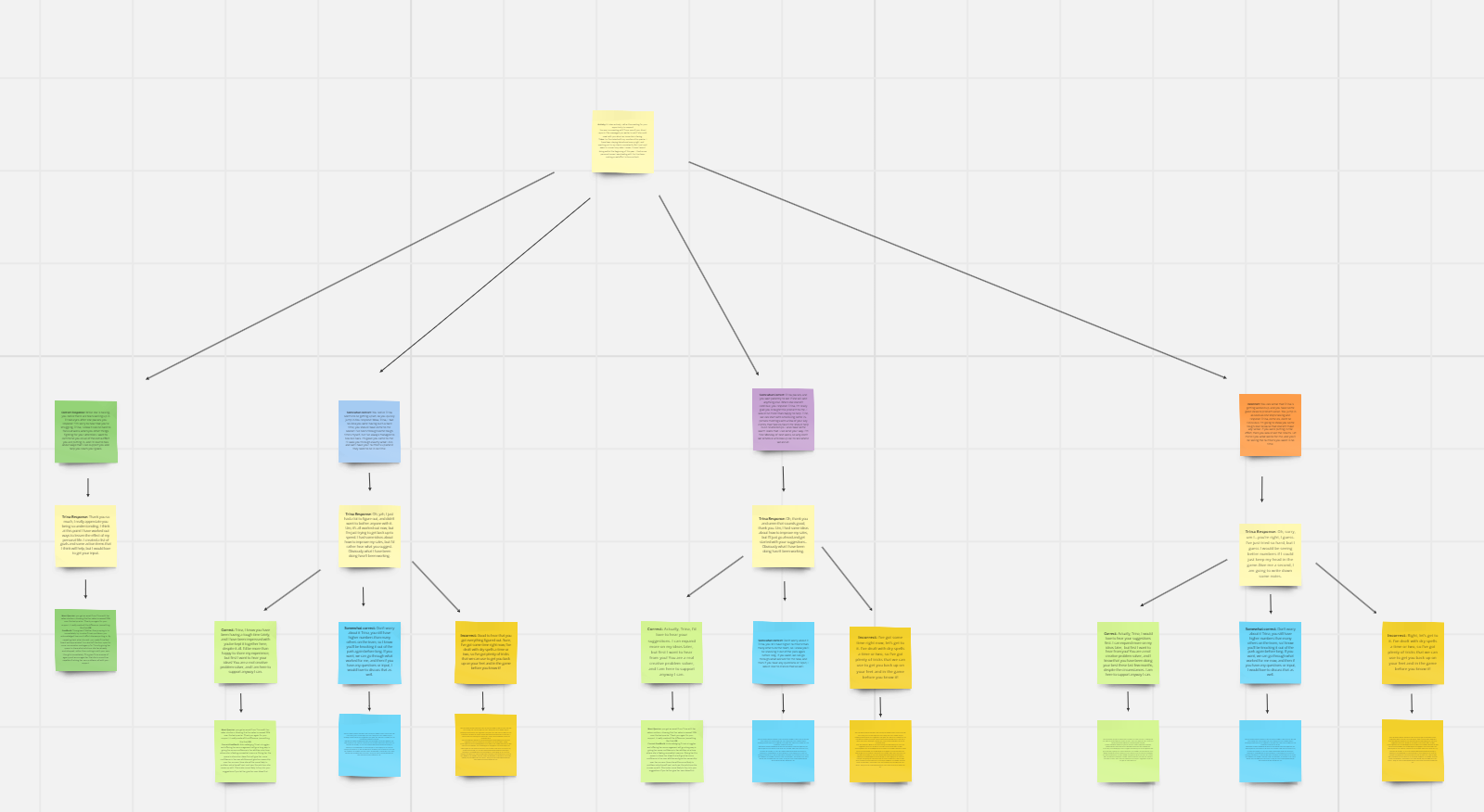
I quickly developed a storyboard with Miro. Recognizing the nuances of real-life situations, I developed branching options for various types of responses. Both "somewhat correct" and "incorrect" responses lead to corrective feedback and a second branch, allowing learners to adjust course after mistakes and improve their responses, aligning with Moore's principles.
Prototype
Next, I developed a prototype of the course, using a variety of tools, including:
With Adobe Illustrator, I created a map of an office where each room represents a different technique to foster a sense of familiarity and immersion for learners.

Using Vyond, I developed immersive videos, featuring realistic characters, dialogue, and locations to enhance engagement.

According to Cathy Moore's principles, I prioritized interactive, engaging scenarios over a simple “information dump.” By avoiding "hand-holding," adult learners are empowered to draw on existing knowledge and apply new skills independently, enhancing their understanding and retention. In Storyline, I included a "Help" option on each decision slide, offering essential knowledge for applying emotional intelligence techniques, if necessary.

-
Emotional Intelligence can be difficult to master because of the subjective nature. With this in mind, I began scripting scenarios that would incorporate the same context and factors the department managers at Corporate Company would encounter on the job and model ideal, emotionally intelligent responses to common, difficult situations. My goal was to prepare the department managers of Corporate Company to effectively apply emotional intelligence techniques and navigate similar situations in their daily lives at the office and even personal lives! This improved communication would ideally lead to better teamwork and achieve Corporate Company’s goal of improving productivity and relationships in the office.
Storyboard
Employing Cathy Moore's principles, I scripted the scenarios and developed a simple storyboard in Miro to visualize the course outcomes and pathways. I used Miro at this point in the process because the platform provided the flexibility to easily rearrange and re-order the scenarios.
Life is not black and white, and because the real life situations where the managers would be applying the techniques from the course would require some nuance, I wanted to provide a range of reactions and consequences in the feedback.
With this in mind, I wrote an option that was “somewhat correct.” In this branch, the learner has correctly applied some of the emotional intelligence techniques, but there is a more effective way to respond to the scenario. For both “somewhat correct” and “incorrect” responses, the learner would receive corrective feedback and be directed to a second branch of the scenario. This is in line with Cathy Moore principles, and allows the learner to utilize the feedback to make a better decision and correct course in the scenario.
After completing the script for my scenarios, I gathered and incorporated feedback from my SMEs and select department managers. I felt it was important to include future learners in the process to confirm the identified behaviors addressed were as relevant and realistic as possible.
Prototype
With my scenarios written, I began developing the elements of a prototype with the following tools:
Adobe Illustrator
I wanted a landing page that was a map of an office. I liked the idea of learners navigating through the course as if it was a virtual office to simulate the feeling of going about their normal day in a familiar environment. I used Adobe Illustrator to create a background where each room represents a different emotional intelligence technique and provides a relevant scenario.
Storyline
This portfolio showcases the Active Listening (“Listen actively rather than waiting for your turn to respond” on the Action Map) module of the Embracing Empathy course. After completing a module, the learner is able to freely select the location of the next scenario. I included triggers in Storyline that clearly indicate which modules the learner has completed.
Within the module, each slide includes triggers to provide appropriate feedback to learners based on their responses. Following Cathy Moore’s suggestions, I avoided an “information dump” and instead provided interactive scenarios for the learners to practice what they know. Not only does this approach avoid “hand-holding,” which can feel infantilizing to adult learners, but it also encourages the learner to draw on what they already know and use the new skills to enhance this knowledge.
Each slide includes triggers to provide tailored feedback based on learner responses, promoting a self-directed learning experience. If the learner does need support or is unsure how to proceed, I included a “Help” option on each slide that provides the essential knowledge required to apply the emotional intelligence techniques in the module. With this option, learners always have assistance, but can access it as needed, instead of having it spoon-fed to them.
Vyond
Inside the module, I used Vyond to create immersive videos with realistic characters that represent personalities or relationships commonly found within an office environment. These characters address the learner directly and in a more casual manner to create more engagement. To optimize the development process, I created a template of the background to use for each branch of this scenario.
Through continuous testing, I refined the interactive prototype to ensure a high-quality learning experience. Again, I gathered feedback from stakeholders to ensure that I was on the right track and incorporated meaningful changes I received to the module. After the module was fully developed and approved by the HR Director, the module was released to learners.
My iterative approach, including continuous testing and applied stakeholder feedback, ensured a high-quality learning experience and refined final product.